
Your New Automation Software Is Going to Fail. (Unless You Use This 5-Step Checklist First)
Bryon Spahn
10/30/20253 min read
Stop me if this sounds familiar... You just sat through a dazzling demo for a new AI-powered "game-changing" automation tool.
The salesperson promised it would solve all your problems. It would save you 20 hours a week, double your leads, and probably make you coffee.
You’re excited. Your team is excited. You sign the $20,000 annual contract.
...and six months later, it’s shelf-ware.
Nobody uses it. It doesn’t "talk" to your other systems. Your team hates it, and you’re locked in for another six months.
This isn’t a tech problem. It’s a selection problem.
We buy shiny new tools based on 10% of the picture—the cool features. We get burned by the 90% we ignored—the integration, the security, the real cost.
Want to stop wasting money and time? Before you buy anything else, you must be able to answer "YES" to all 5 questions on this checklist.
The "Will This Actually Work?" Checklist
1. Did you define the problem before you saw the product?
Most tech purchases fail right here.
We see a cool AI tool and then try to find a problem for it. This is backward.
You must ignore all features and first write a single, clear sentence: "We are struggling with [specific business pain], and it is costing us [time/money]."
If the tool doesn't solve that exact problem, you don't need it.
2. Does it integrate with your current tech stack?
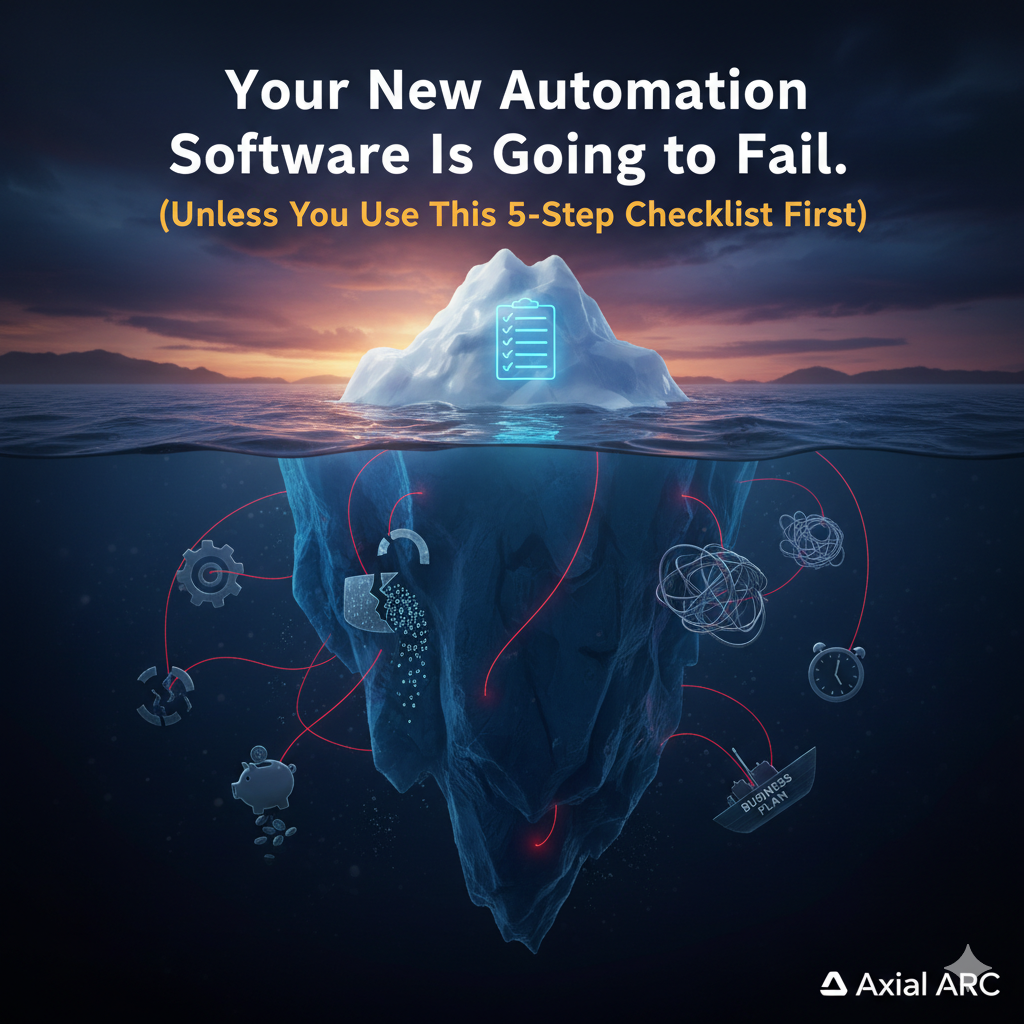
This is the iceberg. The tool is the tiny tip you see. The integration is the 90% of unseen work below the surface that sinks the entire project.
Ask the hard questions:
"Does this have a pre-built integration with our CRM?"
"Will it work with our accounting software?"
"What happens if one of those systems updates? Does this break?"
If the answer is "We have an open API!"—run. That's sales-speak for "You're going to pay a developer for the next 3 months to build it."
3. Does it pass the "Security & Continuity" test?
Congratulations, you just bought a new piece of tech. You also just created a new, shiny backdoor for hackers.
Every new tool, especially AI, is a new security risk.
Where is your data being stored?
Is it compliant with your industry (e.g., HIPAA, SOC 2)?
What happens if this tool goes down? Does your entire operation grind to a halt?
If your tech team hasn't vetted its security and it's not part of your business continuity plan, you're not buying a tool—you're buying a liability.
4. Do you know the Total Cost of Ownership (TCO)?
The license fee is just the cover charge. The real cost is:
Training: How many hours will your team lose to learn this?
Maintenance: Who fixes it when it breaks?
Scaling: What happens when you add 20 more users? Does the price triple?
Integration: (See #2) Who pays for that developer?
If you can't map out the TCO for at least 3 years, you can't afford it.
5. Does it have a clear "Internal Owner"?
Who is responsible for this tool 6 months from now?
Not "the marketing team."
Not "everyone in sales."
You need one name. One person who is responsible for its adoption, a-la-carte, and success. When a project is everyone's responsibility, it's no one's.
Stop Guessing. Start Optimizing.
Here's the truth: This checklist is simple, but executing it is hard.
You’re a business leader, not a cybersecurity expert or an infrastructure architect. Your tech team is already swamped just keeping the lights on. They don't have time to run a 3-week security and integration audit on every potential new tool.
That's where Axial ARC comes in.
We are the strategic technology partners who live and breathe this. We translate complex tech challenges into real business value.
Before you sign that next big contract, let us be your expert advisors. We'll run this checklist with you.
Our Technology Advisory team will validate the TCO and ensure it aligns with your business goals (Step 1 & 4).
Our Infrastructure Architecture experts will map the integrations and expose the hidden "iceberg" costs (Step 2).
Our Cybersecurity and Business Continuity pros will vet the tool to make sure you're not buying a future data breach (Step 3 & 5).
Stop buying tech that fails. It's time to invest in a strategy that wins.
Ready to make your next tech investment a massive success?
Committed to Value
Unlock your technology's full potential with Axial ARC
We are a Proud Veteran Owned business
Join our Mailing List
EMAIL: info@axialarc.com
TEL: +1 (813)-330-0473
© 2026 AXIAL ARC - All rights reserved.