
Prompt Engineering Is a Business Skill Now: What Every Leader Needs to Know About Getting Value from AI Tools
Bryon Spahn
4/9/202621 min read
The Day Jennifer Realized She Was Using AI Wrong
Jennifer is the COO of a mid-sized professional services firm in the Southeast. When her company rolled out an enterprise AI assistant last spring, she was genuinely excited. The pitch had been compelling — faster proposals, smarter research summaries, better first drafts. The license wasn't cheap, but the productivity promise justified it.
Three months later, Jennifer sat in a quarterly business review watching her team shrug. The AI tool was technically deployed across the organization. Most people had logged in at least once. A few used it sporadically. Almost nobody used it consistently or confidently. The hoped-for productivity gains had not materialized, and leadership was quietly starting to wonder if they'd bought a very expensive piece of technology that looked impressive in a vendor demo.
When Jennifer dug deeper, she found the real culprit. It wasn't the tool. It was how her people were using it.
Her team was typing things like: "Summarize this." "Write an email." "Give me ideas." They were getting mediocre outputs, concluding the AI wasn't that impressive, and going back to doing things manually. Nobody had taught them that what you put in determines what you get out — and that getting great outputs requires a specific, learnable skill.
That skill is called prompt engineering. And it is no longer the exclusive domain of developers and data scientists.
It is a business skill. And if your organization has invested in AI tools without investing in prompt literacy, you are almost certainly leaving significant value on the table.
The Hidden Gap Between AI Investment and AI Value
The enterprise AI market is experiencing a surge of investment that is moving faster than most organizations' ability to absorb it. Companies are purchasing AI assistants, embedding models into workflows, and standing up chatbot interfaces for employees and customers alike. By most estimates, global enterprise AI spending has crossed into the hundreds of billions of dollars annually and is accelerating.
Yet adoption surveys tell a more complicated story. A significant percentage of enterprise AI deployments underperform against their stated goals — not because the technology is flawed, but because the humans using it were never trained on how to communicate effectively with it.
This is the hidden gap: the space between what AI tools are technically capable of and what your team is actually getting out of them.
The root cause is almost always the same. Organizations invest in the technology layer. They configure the platform, integrate it with existing systems, manage the security posture, and roll it out with a brief demo or a link to a vendor tutorial. What they rarely invest in is the human layer — specifically, teaching non-technical leaders and knowledge workers how to give the AI clear, contextually rich, well-structured instructions.
This isn't a criticism of the people. It's a systems problem. Nobody was taught this. Most business professionals have spent their careers communicating with other humans — people who can read between the lines, ask clarifying questions, draw on shared context, and make reasonable inferences. AI language models are not humans. They are extraordinarily powerful pattern-matching and synthesis engines that perform in direct proportion to the quality of the instruction they receive. Vague instructions produce vague outputs. Rich, specific, well-framed instructions produce outputs that can genuinely transform how work gets done.
At Axial ARC, we work with organizations across a wide range of industries — and we have observed this gap consistently. In roughly 40% of organizations we assess, we find that foundational understanding of how to work effectively with AI tools is missing at the leadership level. The tools are there. The training is not.
That is the problem this article exists to address.
What Prompt Engineering Actually Means (Without the Jargon)
The phrase "prompt engineering" sounds like something that belongs in a computer science classroom. It doesn't. Strip away the technical vocabulary and what you're really talking about is this: the practice of giving an AI tool a well-crafted instruction so it can give you a well-crafted response.
Think of it like briefing a very talented, very capable new hire on their first day. This person has encyclopedic knowledge, can write in virtually any style, can analyze data, synthesize research, draft communications, and reason through complex problems. But they know nothing about your company, your clients, your tone, your priorities, or what "done" looks like for you. If you walk up to them and say "write me an email," they will write you something generic. If you say "write a follow-up email to our largest healthcare client who just flagged a concern about our implementation timeline — our tone with them is always collaborative and solutions-focused, and I want to acknowledge the concern before pivoting to our mitigation plan," you will get something genuinely useful.
The AI is that talented new hire. Prompt engineering is how you brief them properly.
There are several dimensions to a well-constructed prompt, and understanding each one is what separates leaders who unlock AI value from those who end up frustrated with mediocre outputs.
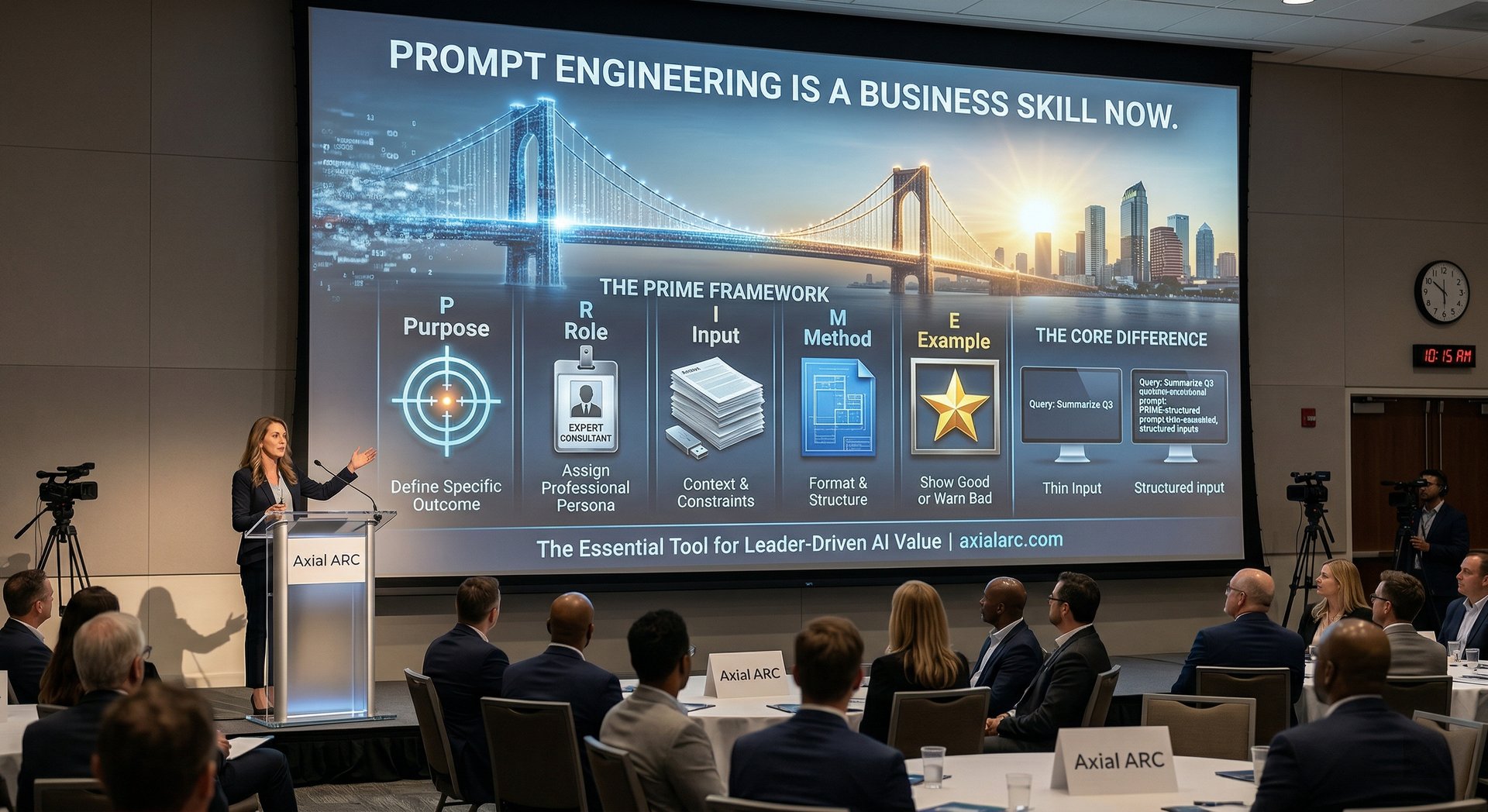
The PRIME Framework: Five Dimensions of an Effective AI Prompt
At Axial ARC, we teach non-technical leaders a practical framework for constructing AI prompts that consistently produce useful, high-quality outputs. We call it PRIME — an acronym that maps to the five dimensions every effective business prompt should address.
P — Persona
R — Role
I — Intent
M — Mode
E — Examples
Each of these dimensions adds a layer of specificity and context that helps the AI understand not just what you want, but how you want it, who it's for, and what success looks like. Let's examine each one in depth.
P — Persona: Tell the AI Who It Should Be
This is one of the most powerful and most underutilized dimensions of effective prompting. When you assign a persona to the AI — essentially asking it to respond as if it were a specific type of expert — you dramatically shift the quality and relevance of the output.
Without a persona, the AI responds as a generalist. With a persona, it filters its knowledge and communication style through the lens of that expert, producing outputs that are more precise, more contextually appropriate, and far more useful.
What persona assignment looks like in practice:
Instead of: "Give me advice on how to handle a difficult employee situation."
With persona: "You are a seasoned HR director with 20 years of experience in the professional services industry. Give me advice on how to handle a situation where a high-performing senior employee has started missing deadlines and showing signs of disengagement."
The second version directs the AI to draw on a specific domain of expertise. The output will sound like advice from someone who has actually managed these situations in a professional services context — with nuance, empathy, and practical specificity — rather than a generic management tips list.
Other strong persona examples for business leaders:
"You are a CFO who specializes in helping mid-market companies prepare for investor conversations..."
"You are a marketing strategist with deep experience in B2B SaaS customer acquisition..."
"You are a seasoned operations consultant who has helped healthcare organizations streamline clinical workflows..."
"You are a senior technology advisor who translates complex IT concepts into plain business language for executive teams..."
The persona doesn't have to be elaborate. Even a short, specific descriptor — "You are an experienced contract attorney reviewing this clause for risk" — meaningfully improves output quality compared to no persona at all.
R — Role: Clarify What the AI Is Doing for You
Role is closely related to persona, but it answers a different question. Persona tells the AI who it should be. Role tells the AI what job it is performing in this specific interaction.
Is it a reviewer? A collaborator? A researcher? A first-draft writer? A devil's advocate? A coach? The role shapes how the AI engages with your request — whether it critiques, generates, synthesizes, explains, or challenges.
Role examples that sharpen outputs:
"Your role is to review this proposal and identify any logical gaps or unsupported claims before I send it to a client."
"Your role is to help me think through the counterarguments to a position I'm about to take with my board."
"Your role is to act as a research assistant and compile a structured summary of what I need to know about this regulatory change."
"Your role is to be a writing coach — read this executive summary and tell me what's working and what should be cut or rewritten."
Notice that role prompts like these do not ask the AI to just "do" something. They define the relationship and the mode of engagement, which produces outputs that are far more targeted and actionable.
I — Intent: State What You're Trying to Accomplish
This is the most intuitive dimension, but it's also the one most frequently underspecified. Intent means telling the AI not just what you want it to produce, but why you need it, who the audience is, and what outcome you're trying to drive.
The AI cannot infer your business context. It doesn't know that this email is going to a client whose contract renewal is at risk. It doesn't know that the presentation you're drafting is for a skeptical board that prefers data over narrative. It doesn't know that the job description you're writing needs to attract senior candidates from a specific industry background.
When you specify intent, you give the AI the business context it needs to make smart decisions about tone, structure, content emphasis, and language.
Weak intent: "Write a proposal for a new technology project."
Strong intent: "Write an executive-level proposal for a network infrastructure modernization project. The audience is our CFO and COO, both of whom are non-technical and highly focused on cost and risk. The goal is to secure approval for a $400K investment. The proposal should lead with business risk if we don't act, then move to solution options and expected ROI."
The difference is not subtle. The first instruction will produce a generic document. The second will produce something you can actually use — or at least a strong first draft that is 80% of the way there.
Strong intent statements include:
Who the audience is and what they care about
What decision, action, or reaction you want the output to drive
Any relevant constraints (budget sensitivity, political dynamics, time pressure)
The context the AI needs to understand what "good" looks like for this situation
M — Mode: Specify the Format and Style of the Output
Mode is about format, length, tone, and structure. Most AI tools are capable of producing outputs in a wide variety of formats — bullet points, structured reports, executive summaries, conversational emails, numbered frameworks, tables, and more. But they default to a generic format unless you tell them otherwise.
Leaders often find AI outputs too long, too generic in tone, or formatted in a way that doesn't match their actual needs. In most cases, this is because mode was not specified.
Mode specifications to include in your prompts:
"Format this as a concise executive summary — no more than 250 words, with three bullet points at the top for quick skimming."
"Write this in a confident, direct tone — no hedging language, no excessive qualifiers."
"Structure this as a problem/solution/benefit framework."
"Give me three distinct options, each with a brief pro/con breakdown."
"Keep this conversational — it's going into a Slack message, not a formal report."
"Write this at a level appropriate for a smart executive who is not a technical expert."
Mode specifications are also where you address style preferences, vocabulary level, and whether the AI should avoid certain kinds of language. If your brand voice is warm and approachable rather than formal and corporate, say so. If your audience hates buzzwords, tell the AI to avoid them.
E — Examples: Show the AI What Good Looks Like
This is the most powerful accelerator in the PRIME framework, and the one most people skip entirely. Providing examples — either of the kind of output you want, or of the tone and style you're targeting — has a dramatic positive effect on output quality.
You can do this by pasting in a previous piece of writing and saying "match this tone." You can describe the kind of output you're looking for. You can tell the AI what you don't want by giving a counterexample. You can share a template and ask it to populate it.
Example-driven prompts:
"Here is a proposal we've used successfully with healthcare clients in the past: [paste document]. Use a similar structure and tone for this new proposal targeting a financial services client."
"Here is an example of a strong executive summary from another project: [paste example]. Write the summary for this project in the same format."
"Avoid sounding like this: 'Leveraging synergistic paradigms to optimize cross-functional value delivery.' Keep the language plain, specific, and human."
"Here is the style guide for our company communications: [paste relevant sections]. All outputs should conform to this guide."
Examples are particularly valuable when you have established brand voice guidelines, preferred formats, or tone standards that are specific to your organization. Rather than trying to describe what you want in the abstract, you show the AI a concrete model of what success looks like.
Putting PRIME Into Practice: Side-by-Side Prompt Comparisons
The best way to internalize the PRIME framework is to see it in action. Below are several real-world business scenarios, each presented with a weak prompt (the kind most leaders default to) and a PRIME-structured prompt that produces dramatically better results.
Scenario 1: Preparing for a Difficult Board Conversation
Weak Prompt: "Help me prepare for a hard conversation with my board about missing our revenue target."
PRIME-Structured Prompt: "You are an experienced executive coach who has worked with CEOs and COOs of professional services firms navigating difficult board conversations (Persona). Your role is to help me prepare talking points and anticipate tough questions (Role). I'm presenting to my board next week after missing our Q3 revenue target by 12%. The board includes two former operators and a finance-focused chair who will want specifics. I need to deliver bad news in a way that maintains credibility, demonstrates accountability, and pivots confidently to our recovery plan (Intent). Format this as a structured prep document with three sections: key messages, anticipated hard questions, and suggested responses. Keep the tone direct and confident — no spin, no deflection (Mode). Here is an example of a message from a previous board communication I want to maintain consistency with: [paste example] (Examples)."
The structured version produces a document a leader can actually rehearse from. The weak version produces a generic list of "tips for hard conversations."
Scenario 2: Drafting a Client Communication After a Service Issue
Weak Prompt: "Write an email apologizing to a client for a service disruption."
PRIME-Structured Prompt: "You are a client success leader known for writing communications that rebuild trust after difficult situations (Persona). Your role is to draft a client-facing email that acknowledges a service disruption without over-apologizing or creating unnecessary alarm (Role). We had a 4-hour outage on our managed IT platform last Tuesday that affected our client's ability to access their document management system. The client is a long-standing relationship who renewed their contract three months ago. Our tone with them is always warm, professional, and direct. We've already resolved the root cause and implemented a monitoring improvement (Intent). The email should be no longer than 200 words, lead with acknowledgment, briefly explain what happened and what we've done, and close with a clear offer to discuss further if they have concerns (Mode). Here is a previous service communication we sent that they responded well to: [paste example] (Examples)."
Scenario 3: Creating a Strategic One-Pager
Weak Prompt: "Write a one-pager about our new service offering."
PRIME-Structured Prompt: "You are a B2B marketing strategist with deep experience in the professional services and technology sectors (Persona). Your role is to create a compelling one-page overview of a new service offering for use in sales conversations with senior decision-makers (Role). The service is a managed AI readiness assessment — we help mid-market companies determine whether their data, infrastructure, and team capabilities are ready to support AI initiatives before they invest in tools. The audience is COOs and CIOs at companies with 200-1,000 employees who have started exploring AI but aren't sure where to start. They are skeptical of hype and respond to credibility, specificity, and honest risk framing (Intent). Format as a one-page document with a headline, a two-paragraph narrative, three bullet points of key outcomes, and a clear call to action. Avoid buzzwords like 'transformative' or 'cutting-edge.' (Mode). Our brand voice is direct, credible, and slightly no-nonsense — like a trusted advisor, not a salesperson (Examples/Style)."
Scenario 4: Research and Synthesis
Weak Prompt: "What are the trends in AI for small businesses?"
PRIME-Structured Prompt: "You are a technology research analyst who specializes in the practical adoption of AI tools by small and mid-sized businesses (Persona). Your role is to produce a structured briefing document I can use to prepare for a strategic planning session with my leadership team (Role). I need to understand the top five practical AI use cases that are showing real ROI for service-based SMBs in 2025 — specifically in the areas of customer service, operations, and marketing. I want to understand not just what the trends are, but where organizations are seeing genuine value versus where the hype exceeds the reality. My team is skeptical of AI hype and will push back on anything that sounds like vendor marketing (Intent). Format as a numbered briefing with a one-paragraph summary per trend, a 'reality check' note for each that identifies limitations or common failure modes, and a final section of three questions my team should be asking vendors (Mode)."
Three Organizations That Changed Their AI Results by Changing Their Prompts
The following are composite case studies drawn from the types of situations Axial ARC routinely encounters with clients. Names and identifying details are illustrative.
Case Study 1: The Franchise Operator Who Stopped Getting Generic Answers
A regional franchise operator with twelve locations in the home services sector had invested in an AI assistant for their administrative and marketing functions. The marketing coordinator was using it to draft promotional emails and social content, but the outputs were consistently bland and off-brand. She had nearly given up on the tool.
When Axial ARC worked with her organization, we observed her prompting approach. She was typing instructions like "write a spring promotion email" with no additional context. The AI had no idea she was targeting homeowners in the Southeast, that her brand voice was warm and neighborly, that her audience valued trust and local presence over price, or that her promotions always anchored to a specific call to action with a deadline.
After a two-hour PRIME framework workshop, her prompts transformed. She began opening every marketing prompt with a persona, specifying her audience demographics and psychographics, describing her brand voice with a concrete example, and including her desired call to action in the intent statement. Within two weeks, her first-draft acceptance rate — the percentage of AI outputs she could use with minor edits rather than complete rewrites — went from roughly 20% to over 70%. The same tool. Dramatically different results.
Case Study 2: The Healthcare Administrator Who Turned AI Into a Thinking Partner
A healthcare operations administrator at a regional medical group was using AI to try to improve internal communication around policy changes. Her initial prompts produced outputs that were either too clinical and jargon-heavy for frontline staff or too simplified for clinical leads. The results were inconsistent enough that she'd stopped trusting the tool.
The issue, as Axial ARC identified it, was that she was treating the AI as a single-mode tool rather than a configurable system. She wasn't specifying her audience within each prompt, which meant the AI was defaulting to a middle-ground register that served neither audience well.
We introduced her to the concept of audience-specific mode specification and helped her build a small library of reusable prompt templates — one for frontline staff communications (conversational, plain language, action-oriented), one for clinical lead briefings (professional, evidence-informed, appropriately technical), and one for administrative reports (structured, data-forward, concise).
The templates took about three hours to build. Within a month, her communications team was producing first drafts three times faster, with significantly fewer revision cycles. More importantly, her clinical leads began commenting that internal communications had noticeably improved in clarity and relevance.
Case Study 3: The COO Who Used AI to Prepare Smarter for Hard Decisions
A COO at a mid-market financial services company — not unlike Jennifer from our opening story — had adopted an AI assistant but was using it primarily for low-stakes tasks like scheduling notes and simple email drafts. She was skeptical that it could add value for the more complex analytical and strategic work her role demanded.
Axial ARC worked with her to explore the strategic use of AI for decision preparation — specifically, using the AI as a scenario planning partner before high-stakes meetings. We helped her build PRIME-structured prompts that asked the AI to steelman opposing arguments, identify risks she might have overlooked, surface questions her board or investors were likely to raise, and synthesize research on topics she needed to understand before a significant vendor negotiation.
Within sixty days, she was using AI as a standard part of her preparation workflow for board meetings, contract negotiations, and strategic planning sessions. She described the shift as going from using AI as a "typing assistant" to using it as a "thinking partner." The tool hadn't changed. Her ability to instruct it had.
The Five Objections Leaders Raise (And Why They Don't Hold Up)
When Axial ARC introduces prompt engineering training to leadership teams, we consistently encounter the same objections. Here's how we address them.
1. "I don't have time to write elaborate prompts."
This objection conflates initial learning investment with ongoing effort. Building your first few well-structured prompts takes more time. But once you understand the PRIME framework and have a small library of reusable templates customized to your most frequent use cases, you will spend less total time on AI-assisted tasks — not more. The time you "save" by using a weak prompt is immediately consumed by editing, revising, and redoing mediocre output.
2. "I'm not technical enough for this."
Prompt engineering at the business level requires zero technical knowledge. You do not need to understand machine learning, neural networks, APIs, or anything that sounds like computer science. You need to be able to write clearly, think about your audience, and describe what you want. Every leader who communicates effectively with human colleagues already has the foundational skills for effective prompting. The only thing missing is a framework.
3. "Our AI tool isn't good enough to justify learning this."
In the vast majority of cases where this objection surfaces, the tool is not the limiting factor — the prompts are. We have seen the same enterprise AI platform produce outputs that ranged from genuinely impressive to entirely useless, depending solely on how the user constructed their request. Before concluding that your tool is underperforming, invest 90 minutes in testing it with PRIME-structured prompts. You will likely be surprised by what it's actually capable of.
4. "We'll just hire someone who knows AI."
This is a tempting shortcut, but it creates a dependency that doesn't scale. If prompt literacy sits in one person, it becomes a bottleneck. Every leader on your team who uses AI tools will get better or worse results depending on how they interact with those tools. Prompt literacy needs to be broadly distributed across your leadership and knowledge worker population, not concentrated in a single individual.
5. "We already did a lunch-and-learn on this."
A one-hour vendor demo or a general awareness session is not training. It's awareness. The difference between awareness and capability is practice, guided by a framework, applied to real business scenarios. Leaders who have "heard about" prompt engineering are not the same as leaders who have practiced it, received feedback, built templates, and applied it to their actual workflows. The goal is not knowing that prompt engineering exists — it's being able to do it fluently.
The 90-Day Roadmap to Building Prompt Literacy Across Your Organization
Building prompt literacy is not a complex initiative, but it does require intentional sequencing. Here is the framework Axial ARC recommends for organizations that want to move from awareness to embedded capability within a quarter.
Phase 1 — Days 1 through 30: Assess, Align, and Anchor
Begin with an honest assessment of how your team is currently using AI tools. What platforms are deployed? Who is using them, how frequently, and for what tasks? What does a typical prompt look like from your average knowledge worker? This baseline assessment is often revealing — and it sets a measurable starting point so you can track improvement.
From there, identify your highest-value use cases. Where in your business would better AI outputs have the most measurable impact — proposal generation, client communications, research and synthesis, operational reporting, performance feedback, meeting preparation? Prioritize two to three use cases per functional area for the initial training focus.
Finally, build alignment at the leadership level. Prompt literacy needs a champion — ideally a senior leader who is visibly practicing and advocating for it. When an executive team uses AI effectively and talks about it openly, the permission structure for the rest of the organization shifts significantly.
Phase 2 — Days 31 through 60: Train, Template, and Test
This is where the PRIME framework gets formally introduced to your leadership and knowledge worker teams. Effective training at this stage is scenario-based and function-specific. Generic AI workshops produce generic results. What produces lasting change is sitting in a room with your sales team working through PRIME-structured prompts for your actual sales scenarios, or working with your operations team to build prompt templates for your actual operational reports.
Build a shared library of prompt templates during this phase. Each template should be pre-structured with the PRIME dimensions filled in for the most common use cases in that function. These templates become the organizational memory — new employees inherit prompt literacy immediately, and experienced employees have a starting point they can customize rather than starting from scratch every time.
Test output quality systematically. For each use case, define what a high-quality output looks like, then compare outputs from PRIME-structured prompts versus baseline prompts. Document the difference. Quantify, where possible, the time savings and revision reduction. These numbers matter when you're making the case to sustain the investment.
Phase 3 — Days 61 through 90: Embed, Evolve, and Expand
In the final phase, the focus shifts from training to embedding. Prompt literacy should become part of your onboarding process, your standard operating procedures for AI-assisted work, and your regular operational rhythm. Monthly or quarterly prompt reviews — where teams share what's working, refine templates, and explore new use cases — keep the capability current as AI tools evolve.
Expand the scope of AI-assisted work based on what you learned in Phase 2. What use cases exceeded expectations? What functions could benefit from applying the same approach? The organizations that build sustainable competitive advantage from AI are not necessarily the ones with the most sophisticated tools — they are the ones that have made AI fluency a persistent organizational capability, not a one-time project.
Why Most AI Training Misses the Point (And What to Do Instead)
There is a growing market for AI training, and most of it is aimed at the wrong thing. Vendor-provided training focuses on feature navigation — here's how to access the chat interface, here's how to attach a document, here's how to start a new conversation. IT-delivered training focuses on security policies and appropriate use. These are necessary, but they do not move the needle on value.
The missing piece is business-context training that meets leaders where they are — in their actual workflows, with their actual use cases, in language that doesn't require a technical background to understand.
This is precisely what Axial ARC's approach delivers. We are not a technology vendor. We are not trying to sell you a new AI platform. We are technology advisors with decades of experience translating complex technology into plain business language — and our AI literacy training reflects that positioning.
Our engagements are structured around your business, not around a generic curriculum. We start by understanding your industry, your roles, your workflows, and your existing AI investments. We then design training that is specific to your context — the prompts your team practices during training are prompts they will use in their actual jobs the following week.
We also believe in honest assessment. Not every organization is at the same point in its AI readiness journey. Some teams need prompt literacy training. Others need foundational infrastructure work before advanced AI capabilities can be deployed effectively. We have the experience to tell you which situation you're in, and the integrity to tell you the truth even when the answer isn't what you were expecting to hear.
If roughly 40% of the organizations we assess have foundational gaps before AI can deliver value — and they do — then part of our role is to help you understand where you actually sit before you invest in the next layer. Sometimes the highest-value thing we can tell a client is: you're not ready for what you think you want, and here's what to do first.
That kind of honest advisory is harder to find than it should be.
The Competitive Dimension: Why This Matters More Than You Think
Prompt literacy is not just an efficiency play. It is increasingly a competitive differentiator.
In every industry where knowledge work is a core function, the organizations whose teams can extract high-quality outputs from AI tools faster, more consistently, and at higher levels of complexity will outperform those that cannot. This isn't speculative — it's the same dynamic that played out with every previous productivity technology, from spreadsheets to search engines to project management platforms.
The leaders who learned to use Excel well didn't just save time — they could perform analysis their competitors couldn't. The organizations that developed sophisticated search and research capabilities made better-informed decisions faster. The same advantage is available now through AI fluency, and it is more accessible than most leaders realize.
The barrier to entry is not budget. Enterprise AI tools are relatively affordable, and several highly capable options exist at the individual user level for minimal monthly investment. The barrier is knowledge — specifically, the knowledge of how to use these tools effectively. That is a trainable skill. And the window during which early adopters can establish a meaningful lead over competitors who haven't yet invested in this capability will not stay open indefinitely.
Organizations that build prompt literacy now — that make it a distributed, embedded capability across their leadership and knowledge worker population — are building a compounding advantage. Every month of effective AI use generates better templates, more refined workflows, and deeper organizational knowledge about where AI creates genuine value and where it doesn't. That institutional intelligence is not easy for competitors to replicate quickly.
What Great AI-Assisted Leadership Looks Like in Practice
Before we close, it's worth painting a picture of what mature, effective AI use looks like in a business leadership context — because the goal isn't just "using AI more." The goal is using it well, in service of outcomes that matter.
A senior leader who has developed genuine AI fluency uses the tool differently than someone who is still finding their footing. They arrive at meetings more prepared, having used AI to research the topic, anticipate counterarguments, and stress-test their own position. They produce first drafts of complex documents faster, because they have prompt templates that reliably generate 70-80% of the work. They use AI as a thinking partner for decisions, asking it to surface risks, identify blind spots, and play devil's advocate before they commit to a direction.
They also know what AI is not good for. They understand that AI outputs require critical review — that the model can be wrong, can miss nuance, and can occasionally produce something that sounds authoritative but doesn't hold up under scrutiny. AI fluency includes knowing when to trust the output and when to verify it. It includes understanding the difference between asking AI to draft something and using AI to think through something. It includes the wisdom to use the tool as an accelerant for your own thinking, not a replacement for it.
This is the leader we are trying to help organizations develop. Not someone who is impressed by AI or afraid of AI, but someone who uses it strategically, confidently, and with clear-eyed awareness of both its power and its limitations.
How Axial ARC Can Help
If the scenarios and gaps described in this article sound familiar, you are not alone. The majority of organizations that have deployed AI tools are in exactly the position Jennifer found herself in at the start of this article — with a capable tool that isn't delivering the value it promised, and a team that doesn't know quite how to fix that.
Axial ARC offers jargon-free AI literacy training designed specifically for non-technical business leaders and knowledge workers. Our engagements are built around your business context, your existing AI tools, and your specific use cases. We don't deliver generic workshops — we deliver practical capability that your team can apply immediately.
Our approach covers not just prompt engineering, but the broader landscape of what AI tools can and cannot do for your organization — so your leaders walk away understanding both how to get the most from the tools you've already invested in and where the opportunities for deeper AI adoption are most likely to pay off.
We also bring the honest advisory posture that has become a hallmark of how we work. If your organization needs foundational work before advanced AI training will stick, we will tell you that. If you're further along than you think and ready to move into more advanced automation and workflow integration, we will tell you that too. Our goal is not to maximize our engagement — it's to maximize your outcomes.
Resilient by design. Strategic by nature. Axial ARC
Committed to Value
Unlock your technology's full potential with Axial ARC
We are a Proud Veteran Owned business
Join our Mailing List
EMAIL: info@axialarc.com
TEL: +1 (813)-330-0473
© 2026 AXIAL ARC - All rights reserved.