
Mission Ready: Applying the OODA Loop to IT Strategy
Bryon Spahn
12/2/202519 min read
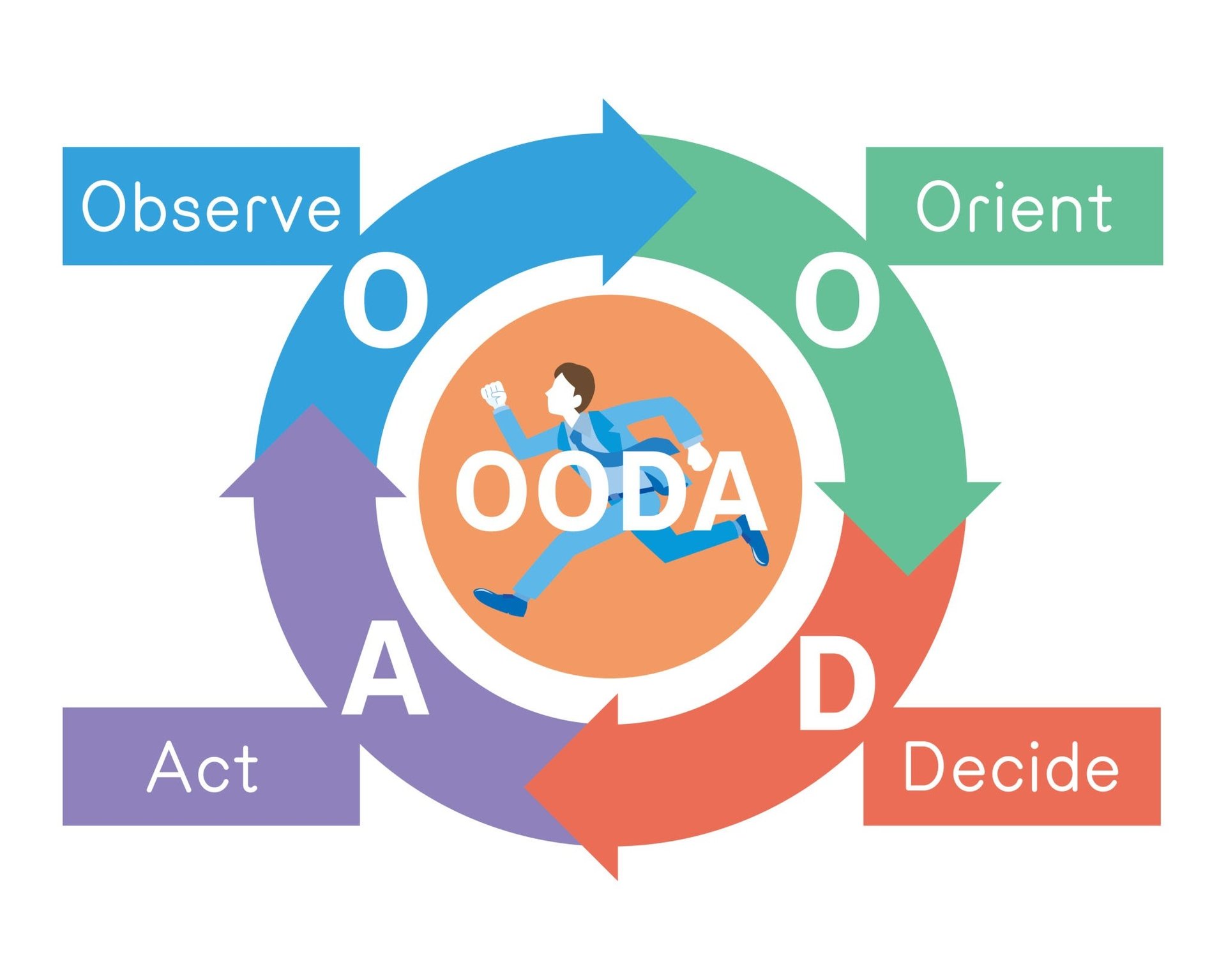
In military operations, the difference between victory and defeat often comes down to one critical factor: decision speed. The side that can observe a situation, process information, make a decision, and act on it faster than their opponent holds a decisive advantage. This principle, formalized by fighter pilot and military strategist Colonel John Boyd as the OODA Loop (Observe, Orient, Decide, Act), has proven equally powerful in the business world—particularly when navigating today's rapidly evolving technology landscape.
At Axial ARC, our veteran-owned heritage means we understand firsthand how military decision-making frameworks translate into business environments where speed, precision, and adaptability determine success. The OODA Loop isn't just a theoretical model—it's a battle-tested approach that technology leaders can implement immediately to transform how their organizations respond to disruption, competition, and opportunity.
The High Cost of Slow IT Decision-Making
Before we dive into the OODA Loop framework, let's establish why decision velocity matters so critically in technology strategy.
Consider these sobering statistics: Companies that fail to adapt their technology infrastructure within 18-24 months of major market shifts lose an average of 23% market share to more agile competitors. Organizations that take more than six months to evaluate and deploy critical technology solutions face implementation costs that are 40-60% higher than faster-moving peers, simply due to opportunity costs, lengthened disruption periods, and changing requirements.
The real penalty isn't just monetary. Slow decision-making creates organizational paralysis. IT teams become reactive instead of strategic. Business leaders lose confidence in technology's ability to drive value. Meanwhile, competitors who can move faster capture market opportunities, attract top talent, and build momentum that becomes increasingly difficult to overcome.
One financial services client came to us after spending 14 months evaluating cloud migration strategies without making a decision. During that period, they experienced three major outages that each cost over $250,000 in direct losses, lost two key engineers to competitors with more modern infrastructure, and watched their customer satisfaction scores decline by 18 percentage points. The cost of indecision dwarfed any risk associated with moving forward strategically.
Understanding the OODA Loop: More Than Just Speed
Colonel Boyd developed the OODA Loop based on observations from aerial combat, where pilots who could cycle through the decision process faster consistently defeated opponents with superior equipment. But the framework's genius lies not just in speed—it's in the relationship between speed and adaptation.
The OODA Loop consists of four phases that form a continuous cycle:
Observe: Gather information about your current situation, environment, and emerging changes. In military terms, this means situational awareness. In IT strategy, it means understanding your infrastructure state, business requirements, competitive landscape, technology trends, security posture, and organizational capabilities.
Orient: Analyze and synthesize the information you've observed, filtering it through your experience, culture, and strategic objectives. This is where you make sense of raw data and identify patterns, threats, and opportunities. Orientation determines what you pay attention to and how you frame decisions.
Decide: Choose a course of action based on your orientation. This isn't about making perfect decisions—it's about making good-enough decisions with the information available, knowing you'll cycle through the loop again to adjust as needed.
Act: Execute your decision rapidly and observe the results, which feeds back into your next observation phase.
The power of the OODA Loop lies in its cyclic nature. You're never making one final decision—you're constantly iterating, learning, and adjusting. This transforms decision-making from a paralyzing, high-stakes event into an agile, continuous process.
Why Traditional IT Planning Fails the OODA Test
Most organizations approach IT strategy with planning cycles that are fundamentally incompatible with today's rate of change. Consider the typical annual planning process:
Quarter 1: Gather requirements and assess current state
Quarter 2: Evaluate options and conduct vendor analysis
Quarter 3: Build business cases and seek approvals
Quarter 4: Plan implementation for next year
By the time decisions are made, the environment has shifted. Requirements have changed. New technologies have emerged. Competitors have moved. The careful analysis that felt prudent has become a liability.
This waterfall approach to IT decision-making creates three critical vulnerabilities:
Extended Observation Phases: Organizations spend months gathering data instead of establishing continuous observation mechanisms. By the time they finish their assessment, much of the information is outdated. A manufacturing client spent nine months conducting a comprehensive infrastructure assessment. When they finished, containerization had matured enough to change their optimal architecture completely, requiring them to restart significant portions of their analysis.
Analysis Paralysis in Orientation: Leaders become so focused on perfect information and risk elimination that they never reach the decision phase. One healthcare organization we encountered had evaluated 17 different cloud platforms over three years without making a selection, spending over $400,000 on consulting fees while their legacy infrastructure continued degrading.
Batch Decisions Instead of Continuous Action: Instead of smaller, iterative decisions that can be quickly validated or corrected, organizations make large, infrequent decisions that are difficult to reverse. This artificially raises the stakes and slows velocity even further.
The OODA Loop provides an antidote to these patterns by emphasizing speed of iteration over perfection of individual decisions.
Observe: Building Real-Time Technology Intelligence
The first phase of the OODA Loop demands that you build mechanisms for continuous observation rather than periodic assessment. This means transforming IT from a department that generates quarterly reports into an intelligence operation that maintains constant situational awareness.
Establishing Your Observation Infrastructure
Effective observation in IT strategy requires multiple intelligence streams:
Infrastructure Telemetry: Real-time monitoring of system performance, capacity utilization, failure patterns, and security events. Organizations with mature observability practices detect and respond to issues 73% faster than those relying on periodic reviews. One client reduced their mean-time-to-detection from 4.2 hours to 12 minutes by implementing comprehensive observability, preventing an estimated $1.8M in annual downtime costs.
Business Performance Indicators: Direct feeds showing how technology decisions impact business outcomes. This means tracking metrics like transaction processing times, customer experience scores, revenue per employee, and cycle times—not just technical metrics like uptime and throughput. When technology teams can see that a 100ms improvement in page load time correlates with a 1.2% increase in conversion rates, decisions become clearer and faster.
Competitive Intelligence: Systematic monitoring of how competitors and industry leaders are leveraging technology. This doesn't mean copying what others do, but understanding the pace and direction of change in your market. A retail client established a competitive technology intelligence function that identified emerging trends 4-6 months earlier than their previous ad-hoc approach, allowing them to be first-to-market with several key customer experience innovations.
Technology Landscape Scanning: Structured monitoring of emerging technologies, platform updates, security vulnerabilities, and regulatory changes. Rather than waiting for major disruptions to force attention, leading organizations maintain continuous awareness of their technology environment.
Organizational Feedback Loops: Direct channels for understanding how technology decisions impact employees, customers, and partners. This includes support ticket analysis, user feedback sessions, and direct engagement with stakeholders who experience your technology choices daily.
The goal isn't to collect more data—it's to build the capability to continuously understand your situation without launching major assessment initiatives. One financial services client reduced their infrastructure assessment cycle from quarterly (with 6-week lag time) to daily automated reporting with real-time alerts for significant changes. This transformed their ability to identify and respond to both problems and opportunities.
Overcoming Observation Obstacles
Organizations typically face three barriers to effective observation:
Siloed Information: Data exists in disconnected systems that different departments control. Creating a unified view requires both technical integration and organizational alignment. Start by identifying your three most critical decision types and ensuring you have integrated data flows for those decisions, then expand.
Signal vs. Noise: More data often means more confusion. Effective observation requires ruthless prioritization. Define what "mission critical" means for your organization and build observation capabilities around those areas first. One client reduced their infrastructure monitoring dashboards from 47 different views to 5 strategic dashboards, cutting the time leadership spent reviewing data from 6 hours weekly to 45 minutes while improving decision quality.
Delayed Recognition: Even with good data, organizations often fail to recognize significant changes quickly. Establish clear thresholds and triggers that automatically elevate important changes to decision-makers. If your cloud costs increase by 30% month-over-month, that should generate an immediate alert, not appear buried in a quarterly report.
Orient: Transforming Information Into Strategic Insight
Boyd considered orientation the most important phase of the OODA Loop. Your orientation—the mental models, experiences, and frameworks you use to interpret information—determines what you see as threats versus opportunities, what you consider possible versus impossible, and ultimately what decisions you consider.
In IT strategy, orientation failures are often more damaging than information gaps. Organizations look at the same data and reach wildly different conclusions based on how they frame the problem.
Building Strategic Orientation Capabilities
Effective orientation in technology decision-making requires several critical elements:
Cross-Functional Perspective: Technology decisions can't be oriented solely through a technical lens. The most effective orientation brings together business strategy, financial analysis, operational requirements, risk management, and technical feasibility. A healthcare client restructured their technology steering committee to include equal representation from clinical operations, finance, and IT. Decision quality improved immediately, and they reduced the time from initial concept to approval by 42%.
Experience-Based Pattern Recognition: Organizations with deep experience in their industry can quickly recognize patterns that others miss. This is where veteran-owned firms like Axial ARC provide distinct value—we've seen similar challenges across dozens of organizations and can accelerate your orientation phase by helping you recognize what matters and what doesn't.
Explicit Decision Frameworks: Rather than operating on intuition, establish clear criteria for how you'll evaluate technology decisions. What matters most: reducing cost, improving capability, mitigating risk, or enabling growth? When are you willing to accept higher costs for lower risk? What's your tolerance for bleeding-edge versus proven technology? Having these frameworks explicit and agreed-upon dramatically accelerates orientation.
Cultural Considerations: Your organization's culture, risk tolerance, and change capacity shape what's realistic. A startup can orient toward aggressive technology adoption that would be reckless for a regulated healthcare provider. Understanding these cultural factors prevents wasting time on solutions that won't work in your specific environment, regardless of technical merit.
Strategic Context: Every technology decision should be oriented through your broader business strategy. If you're pursuing aggressive growth, that should shift how you evaluate scalability versus efficiency. If you're focused on operational excellence, that changes how you weigh proven stability versus innovative capabilities.
The Orientation Workshop: Accelerating Strategic Alignment
One of the most effective techniques we've deployed with clients is the rapid orientation workshop. When facing significant technology decisions, bring together your key stakeholders for a focused session that explicitly works through orientation:
Information Review (30 minutes): Present the observed facts without interpretation or recommendations
Frame Setting (45 minutes): Explicitly discuss the strategic context, success criteria, constraints, and risk tolerance
Pattern Analysis (60 minutes): Identify similar situations you've faced or seen, what worked, what failed, and why
Option Generation (45 minutes): Develop 3-5 distinctly different approaches, not just variations on one idea
Decision Criteria (30 minutes): Establish clear criteria for how you'll evaluate options
This structured orientation process, completed in a half-day session, can replace months of disconnected analysis and misaligned perspectives. A manufacturing client used this approach to orient around a major ERP replacement decision. What had been a 16-month evaluation with no clear consensus became a 6-week process with strong alignment, saving over $200,000 in extended evaluation costs alone.
Avoiding Orientation Traps
Several common traps derail effective orientation:
Confirmation Bias: Seeking information that supports predetermined conclusions rather than genuinely orienting to reality. Combat this by explicitly seeking disconfirming evidence and inviting perspectives from those who disagree with initial assessments.
Recency Bias: Over-weighting recent events and under-weighting longer patterns. A single security incident shouldn't reshape your entire security strategy, just as one successful project doesn't validate an entire approach.
Authority Over Analysis: Deferring to whoever speaks most confidently or holds the highest title rather than rigorously working through the orientation process. The best decision-makers create environments where junior team members can challenge orientation and senior leaders welcome that input.
Perfectionism: Waiting for complete information before orienting. In rapidly changing environments, you must orient with incomplete information and update your orientation as you cycle through the loop.
Decide: From Analysis to Committed Action
The decision phase is where many organizations falter. After weeks or months of observation and analysis, leaders still hesitate to commit to a path forward. The OODA Loop framework provides clarity: the goal isn't perfect decisions, it's timely decisions that you can quickly validate and adjust.
Decision-Making in High-Velocity Environments
Military decision-making doctrine distinguishes between tactical, operational, and strategic decisions based on timeframe and impact. Apply similar thinking to technology decisions:
Tactical Technology Decisions (Days to Weeks): These affect immediate operations but are reversible. Examples include scaling resources, adjusting configurations, or implementing specific features. These should be decided quickly by empowered teams closest to the work. One client reduced their tactical decision cycle from an average of 12 days to 48 hours by establishing clear decision authority and approval thresholds.
Operational Technology Decisions (Weeks to Months): These affect how systems operate and interact but don't fundamentally change your architecture. Examples include adopting new development tools, implementing monitoring solutions, or migrating specific workloads. These warrant more analysis but should still move quickly. Decision timeframes of 2-6 weeks are appropriate.
Strategic Technology Decisions (Months to Quarters): These establish long-term direction and are costly to reverse. Examples include cloud platform selection, architecture patterns, or major infrastructure investments. These warrant thorough orientation but shouldn't extend beyond a quarter without clear justification.
The key insight: not every decision deserves the same process. By categorizing decisions appropriately, you can accelerate tactical and operational decisions while ensuring strategic decisions receive adequate rigor.
The 70% Solution Principle
Military leaders understand that a good plan executed now is better than a perfect plan executed too late. Apply the 70% solution principle to technology decisions: when you have approximately 70% of the information you'd like and a solution that addresses at least 70% of your requirements, decide and act.
This doesn't mean being reckless. It means understanding that the last 30% of information often takes as long to gather as the first 70%, while adding minimal decision clarity. Meanwhile, competitors are acting, circumstances are changing, and opportunity costs are mounting.
A logistics company we worked with applied this principle to their infrastructure modernization decision. Instead of continuing their evaluation process (then in month 11 of a planned 6-month assessment), they decided to proceed with a phased approach. They selected their cloud platform, started with a pilot migration of 15% of workloads, and learned more in the first 60 days of implementation than they had in the previous 11 months of analysis. The pilot validated their approach, revealed several implementation issues they corrected before full rollout, and delivered $140,000 in annual cost savings immediately.
Building Decision Confidence Through Risk Management
Rapid decisions require confidence that you can manage downside risks. This means:
Establishing Rollback Capabilities: Before making major changes, ensure you can quickly return to previous states if necessary. This is why Infrastructure as Code and immutable infrastructure patterns are so valuable—they make it safe to move fast.
Defining Clear Success Criteria: Know what "working" looks like before you implement. This allows you to quickly assess whether your decision was correct and adjust if needed.
Creating Decision Points: Break large decisions into phases with explicit decision points. "We'll implement phase one, assess results against these criteria, then decide on phase two." This transforms high-stakes binary decisions into manageable iterative choices.
Maintaining Optionality: Where possible, make decisions that preserve future flexibility rather than locking you into a single path. Sometimes accepting a 10-15% cost premium for increased optionality is the right strategic choice.
One financial services client was paralyzed around cloud strategy because of concerns about lock-in. By explicitly designing for portability (using containerization and abstraction layers), they reduced their theoretical switching costs by 70% and gained the confidence to move forward aggressively with a primary cloud provider while maintaining real optionality.
Act: Rapid Implementation with Built-In Learning
The final phase of the OODA Loop—Act—is where intention becomes reality. But in the OODA framework, action serves dual purposes: executing your decision and generating observations for the next cycle. This makes implementation fundamentally different from traditional "deploy and hope" approaches.
Implementing for Learning
Effective action in the OODA Loop means instrumenting your implementations to generate clear feedback:
Define Observable Outcomes: Before implementing, establish what you'll measure to determine success. If you're migrating to cloud infrastructure, don't just track "migration complete." Track performance changes, cost impacts, operational burden shifts, and business capability improvements. One client established 12 specific metrics before their cloud migration and tracked them weekly. This allowed them to identify and correct cost overruns within the first month, preventing what would have been a $75,000 annual overspend.
Implement in Observable Increments: Rather than big-bang deployments, break implementations into smaller chunks that generate feedback quickly. This isn't just about risk management—it's about accelerating your learning cycle. A retail client restructured their infrastructure modernization from a 14-month single-phase project into eight 6-week iterations. They delivered business value 9 months earlier and avoided three major architectural mistakes by learning and adjusting as they went.
Create Feedback Mechanisms: Establish clear channels for understanding how implementations impact operations, customers, and business outcomes. This includes automated monitoring, user feedback collection, and regular touch-points with stakeholders. Don't wait for problems to surface organically—actively seek feedback.
Plan Adjustments Into Schedules: Traditional project management treats changes as failures. OODA Loop thinking treats adjustments as expected and necessary. Build time and budget for learning and adapting into your implementation plans from the start.
The Velocity-Quality Balance
A common concern about rapid action is quality. Won't moving fast create problems? The answer lies in understanding that quality and speed aren't opposites—they require different approaches.
Automated Quality Checks: Use automation to ensure consistent quality without slowing velocity. Automated testing, security scanning, configuration validation, and deployment verification can happen in seconds, catching issues that manual reviews might miss while dramatically accelerating implementation.
Clear Standards and Patterns: Establish architectural patterns and implementation standards that teams can apply rapidly without constant re-evaluation. When teams know the approved patterns, they can move fast while maintaining consistency.
Empowered Teams: Push decision authority to the teams doing the work. In military operations, junior leaders execute according to commander's intent without waiting for approval on every tactical decision. Apply the same principle to technology teams. A healthcare client reduced their change approval time from an average of 8.5 days to 4 hours by empowering teams to approve low-risk changes while maintaining rigorous oversight on high-risk changes.
Learning From Failures: Rapid action means some implementations won't work as planned. The difference between high-velocity organizations and reckless ones is learning. Conduct rapid retrospectives after both successes and failures. What did you learn? What will you do differently? How will you share this learning across the organization?
Measuring Action Effectiveness
Track metrics that reveal whether your action phase is working effectively:
Cycle Time: How long from decision to measurable outcome? Leading organizations cut this time by 60-80% through OODA Loop thinking.
Learning Velocity: How quickly are you identifying what works and what doesn't? If you're waiting months to understand implementation effectiveness, you're moving too slowly.
Adjustment Frequency: How often are you making course corrections based on feedback? Frequent small adjustments indicate healthy learning. Infrequent large adjustments often signal you're not cycling through the loop fast enough.
Outcome Achievement: Are your actions delivering the business outcomes you expected? Ultimate success isn't completing implementations—it's achieving business value.
Accelerating Your OODA Loop: The Axial ARC Approach
At Axial ARC, we've specialized in helping organizations implement OODA Loop thinking in their technology strategy and infrastructure architecture. Our veteran-owned perspective brings distinct advantages to this work.
Military organizations have refined the OODA Loop over decades because hesitation in high-stakes environments carries severe consequences. We understand this viscerally and bring that urgency to technology decision-making. But we also understand that business environments have different constraints, risk profiles, and success criteria than military operations. The art is adapting the framework appropriately.
Our Three-Phase Engagement Model
When partnering with organizations to accelerate their technology OODA Loop, we typically structure engagements in three phases:
Phase 1: Current State Assessment and Loop Mapping (2-3 weeks)
We analyze your existing decision processes to understand where time is consumed and where bottlenecks exist. This isn't a comprehensive infrastructure assessment—it's focused specifically on understanding your decision velocity. Where do decisions stall? What information gaps slow orientation? What organizational dynamics prevent rapid action?
We typically find that organizations have pockets of high velocity surrounded by vast areas of paralysis. Our goal is understanding why, which requires both technical and organizational analysis.
Expected outcomes: Clear visualization of your current decision loops, identification of velocity bottlenecks, and quantified cost of decision delays.
Phase 2: Loop Acceleration Design (3-4 weeks)
Working with your leadership team, we design targeted interventions to accelerate your OODA Loop. This might include establishing new observability capabilities, restructuring decision processes, implementing enabling infrastructure, or redesigning organizational interfaces.
The key is focusing on leverage points where modest investments yield disproportionate velocity improvements. For one manufacturing client, we identified that 73% of infrastructure decisions were waiting on cost projections that required manual analysis. By implementing automated cost modeling, we reduced the average decision cycle from 6.2 weeks to 1.8 weeks for that category of decisions.
Expected outcomes: Detailed acceleration plan with specific initiatives, ROI projections, and implementation roadmap.
Phase 3: Rapid Implementation and Optimization (8-16 weeks)
We implement the acceleration initiatives, working side-by-side with your teams to embed OODA Loop thinking into operations. This includes establishing new observation mechanisms, conducting orientation workshops, defining decision frameworks, and implementing enabling infrastructure.
Critically, we measure results from the start. We track decision velocity, implementation cycle times, and business outcomes to ensure initiatives deliver promised value. Based on initial results, we adjust approaches and priorities—applying OODA Loop thinking to our own work.
Expected outcomes: Measurably faster decision cycles, demonstrated business value from acceleration, and teams equipped to maintain velocity improvements independently.
Real-World Results
A regional healthcare provider engaged us after struggling with multi-year infrastructure modernization initiatives. Their technology environment was increasingly fragile, but their decision processes were so slow that modernization efforts couldn't keep pace with degradation.
Through our OODA Loop acceleration approach, we helped them:
Reduce infrastructure decision cycles from 14 weeks to 3.5 weeks average (75% improvement)
Implement continuous observation capabilities that surfaced a critical capacity issue 6 weeks before it would have caused a major outage (preventing estimated $800,000 in business impact)
Restructure their technology steering process, cutting meeting frequency from weekly to bi-weekly while increasing decision throughput by 60%
Complete their cloud migration 8 months ahead of schedule, delivering $1.2M in annual infrastructure cost savings earlier than planned
Reduce unplanned downtime by 68% through faster identification and response to emerging issues
Perhaps most importantly, their technology leadership reported dramatically reduced stress and increased confidence in their strategic direction. Fast decisions aren't just good for business—they're good for the people making them.
Building Your OODA Loop Culture
Implementing OODA Loop thinking isn't just about process changes—it requires cultural shifts. Several cultural attributes enable rapid decision cycles:
Bias Toward Action: Organizations must value executed decisions over perfect analysis. This doesn't mean abandoning rigor, but it means understanding that perfect information is rarely available and waiting for it has real costs.
Learning Orientation: Rapid decision cycles only work if you learn from outcomes quickly. This requires psychological safety where teams can acknowledge what didn't work without fear of punishment.
Distributed Authority: Slow organizations centralize too many decisions. Fast organizations push authority to the edge while maintaining strong communication and alignment.
Strategic Clarity: When everyone understands the organization's strategic direction and priorities, decisions at all levels can move faster without constant escalation and alignment.
Comfortable With Ambiguity: The OODA Loop accepts that you won't have complete information. Organizations must develop comfort operating with acceptable levels of uncertainty.
Leading the Cultural Transformation
Technology leaders can drive cultural change through several mechanisms:
Model the Behavior: Make visible decisions using OODA Loop principles. When you demonstrate rapid cycling with clear observation, orientation, decision, and action phases, others see it's possible.
Celebrate Fast Learning: When teams move quickly, learn, and adjust, recognize that publicly. Make heroes of people who make good decisions fast, not just those who make perfect decisions slowly.
Change the Metrics: If you measure teams on flawless execution, you'll encourage slow, risk-averse behavior. If you measure learning velocity and business outcomes, you'll encourage OODA Loop thinking.
Invest in Enabling Infrastructure: Provide teams with the observability, automation, and architectural patterns that make rapid action safe. Without these enablers, asking for speed is asking for recklessness.
Create Learning Forums: Establish regular forums where teams share what they learned from recent decisions—both successes and failures. This accelerates organizational learning and builds collective orientation capabilities.
Common Pitfalls and How to Avoid Them
Organizations implementing OODA Loop thinking typically encounter several challenges:
Mistaking Speed for Recklessness: The OODA Loop is about rapid cycling through a disciplined process, not skipping steps. Ensure teams understand that all four phases matter—they just need to happen faster.
Inconsistent Application: Some teams embrace rapid decision cycles while others maintain slow processes. This creates friction and dependencies that limit overall velocity. Work systematically to accelerate across the organization.
Observation Without Action: Some organizations become excellent at gathering data but never actually decide and act. Analysis is only valuable when it leads to action.
Action Without Observation: The opposite problem—implementing rapidly without establishing feedback mechanisms. This creates thrashing rather than learning.
Cultural Misalignment: Leadership says they want speed but punishes failures. Compensation and recognition systems reward slow, safe decisions. Without addressing these misalignments, process changes won't stick.
The Strategic Advantage of Decision Velocity
Let's return to the fundamental question: why does this matter?
In today's technology environment, advantage is temporary. The infrastructure choice that's optimal today may be suboptimal next year. The security approach that's effective now may be inadequate in six months. The development methodology that works for your current team size won't scale to twice the size.
Success doesn't come from making one perfect long-term decision. It comes from making good decisions quickly, learning from the results, and adjusting faster than competitors can respond.
Organizations that master OODA Loop thinking in technology strategy gain several compounding advantages:
Continuous Optimization: While competitors make big decisions every 2-3 years, you're making smaller adjustments every quarter or month, continuously optimizing your infrastructure and operations.
Faster Innovation: You can experiment with emerging technologies safely, learning what works through small implementations rather than waiting for case studies from other organizations.
Better Risk Management: Counterintuitively, rapid decision cycles reduce risk. Smaller decisions carry less risk individually, and fast feedback loops allow you to identify problems before they compound.
Talent Attraction: Top engineers and technology leaders want to work in environments where they can move fast, learn quickly, and see impact. OODA Loop organizations attract and retain better talent.
Competitive Edge: When you can respond to market changes, customer needs, and competitive threats faster than rivals, you win. That advantage compounds over time.
Taking the First Step
If you're a technology leader reading this and recognizing that your organization's decision velocity isn't where it needs to be, here's how to start:
Week 1 - Assessment: Map out your three most recent significant technology decisions. How long did each phase take? Where did time get consumed? What information gaps existed? What organizational dynamics slowed progress?
Week 2 - Quick Wins: Identify one category of tactical decisions that currently require extensive approval and establish clear criteria for teams to make these decisions independently. Measure the impact on decision velocity.
Week 3 - Observation Investment: Implement one new observability capability that addresses a current blind spot in your understanding of infrastructure or operations.
Week 4 - Team Workshop: Conduct an orientation workshop on a pending decision using the structure outlined earlier. Experience how explicit orientation accelerates alignment and decision quality.
These initial steps won't transform your organization overnight, but they'll demonstrate the power of OODA Loop thinking and build momentum for broader change.
Partner With Experts in Rapid Technology Strategy
At Axial ARC, we've built our practice around helping organizations translate complex technology challenges into tangible business value—and we do it through velocity. Our veteran-owned perspective brings battle-tested decision frameworks that we've refined through work with dozens of organizations across industries.
We understand that you didn't get into technology leadership to spend your time in endless evaluation cycles and committee meetings. You got into it to build capabilities, drive innovation, and create business value. The OODA Loop provides a framework to do exactly that.
Whether you're facing immediate infrastructure decisions, planning multi-year modernization initiatives, or simply frustrated with how slowly your organization moves, we can help accelerate your velocity while improving your decision quality.
Our approach is practical, not theoretical. We work side-by-side with your teams to implement changes and deliver measurable results. We're not interested in recommendations that sit on shelves—we're committed to helping you achieve real business outcomes.
Ready to accelerate your organization's technology decision-making? Let's talk about how the OODA Loop can transform your IT strategy from a source of frustration into a competitive advantage.
Contact us today to schedule a consultation. We'll start by understanding your specific challenges, then show you exactly how we'd accelerate your decision velocity and measure the impact.
In military operations, the side that can complete their OODA Loop faster wins. In technology strategy, the same principle applies. The question is: will your organization be the one that moves first, learns fastest, and adapts most effectively?
The choice is yours. The time to act is now.
Axial ARC is a veteran-owned technology consulting firm specializing in Infrastructure Architecture, AI & Automation, and Technology Advisory services. With over three decades of technical expertise, we help organizations optimize IT investments, mitigate risk, and accelerate innovation through strategic guidance and rapid implementation.
Committed to Value
Unlock your technology's full potential with Axial ARC
We are a Proud Veteran Owned business
Join our Mailing List
EMAIL: info@axialarc.com
TEL: +1 (813)-330-0473
© 2026 AXIAL ARC - All rights reserved.